Showing posts with label nonfiction. Show all posts

Sunday, December 11, 2011

Rosie the riveter

 
Colman. P. (1995). Rosie the riveter: Women working on the Home Front in World War II. New York, NY: Crown Publishers, Inc.

Interest Level: Grades 5-8
Reading Level: 8+

Rosie the Riveter begins with a brief overview of World War II and how America came to take part in the War as seen through the eyes of Dot Chastney, a third grader at the time. Dot had a personal connection to what was going on in Europe because her neighbor, Annie Ashworth was taking the trip of her lifetime there and Dot's family was concerned for her safety. From that personal female perspective on the war we are introduced to the role that women were encouraged to take while men were away fighting the war. The government created a large scale propaganda campaign and "Rosie the Riveter," the title of an upbeat song of the time, quickly became the catchphrase to represent all women workers. During this time period women held jobs of all kinds in all industries, from shipyards to steel mills, from foundries to farms, and as engineers, physicists, chemists and more. Black women were also encouraged to work, but were segregated from white women workers. Finally, the book covers the propaganda campaign that was began as the war ended and men returned home, which encouraged women to return to being housewives where they belonged.

This is a brief look at the ways that American women contributed to the success of the Wartime activities and yet were discriminated against in the workplace once soldiers began to return home, a discrimination which continued for decades to come. Real accounts of women on the job, accompanied by many photos, make this an interesting read. I was surprised to find out that the image I've always associated with Rosie the Riveter was in fact created in the 1970s. The initial image, painted by Norman Rockwell, can be seen on the cover of the book. This is a good read for those interested in American History as well as those interested in women's rights.

The forensic anthropologist


Yancey, D. (2006). The forensic anthropologist. Farmington Hills, MI: Lucent Books.
Interest level: Grades 6+
Reading level: 10+

Part of the Crime Scene Investigations series, this book introduces readers to a specialty many may think their familiar with through TV shows like CSI and Bones. All aspects of forensic anthropology are addressed here, from fieldwork to the lab or classroom. The perception that these specialists are not welcome by police or at crime scenes is debunked, pointing out that because anthropologists are trained at fieldwork they are a welcome addition at burial sites. The chapters build upon each other. The introduction gives a brief description of this unusual scientific field and introduces some of the field's most respected scientists. Chapter one takes us to the field, detailing what happens in the recovery of bones. Chapter two takes us to the lab where the bone experts determine whether they have human or animal remains, reconstruct what they can of the skeleton and determine characteristics such as sex, height and race as well as extract DNA. Chapter three details how the scientists use their knowledge to help determine cause of death while chapter four discusses the challenges found when unearthing mass graves. In chapter five readers learn about the reconstruction of the bones and the creation of 3D models. There are extensive supporting notes and a lengthy "Further readings" section. Each chapter also includes many account of actual cases where the methods were used and cases were solved.

This is a solid book for anyone interested in crime scene investigations and more specifically in solving cold cases. Information about the educational path one must take to become a forensic anthropologist as well as the agencies that hire them is plentiful and readers can clearly see the value of such a career. The writing is clear and easy to follow and would be accessible and pertinent to both middle school aged kids and those in upper grades. This book would be a good supplement in Life Science classes or in high school Anatomy and physiology classes.

Brainjuice: American history, fresh squeezed


Shields, C.D. (2002). Brainjuice: American history fresh squeezed. Brooklyn, NY: Handprint Books.
Interest level: Grades 4-8

Books in this series offer a sometimes humorous look at different curricular topics through poetry. In this volume, the top of each page features a timeline of events that impacted American History. The poems are arranged chronologically, with the first one being about the very first Americans- dinosaurs and ending with a poem about the September 11th attacks from the Statue of Liberty's viewpoint. Each poem features illustrations that further the understanding of what the poem is about.

This is a good book for anyone interested in American History. It would be a particularly good classroom resource either before or after a particular topic is discussed to grab students' interest. For instance the poem "Job Available," which is about Sacajawea and the Lewis and Clark Expedition ("Opening for a teenage girl/ (With baby in a pack):/ Help lead an expedition/ Twelve hundred miles and back...") could be used as an interest grabber when starting the unit and also as a wrap up poem to refresh students' memories. All books in this series would also be good for poetry units in English classes.

Thursday, December 8, 2011

technically, IT'S NOT MY FAULT


Grandits, John (2004). Technically, it's not my fault. New York, NY: Clarion Books.
Interest Level: Grades 4-8
Reading Level: 3+

This book introduces Robert through a series of concrete poems. Robert is just your typical kid. Technically, it’s not his fault things don’t always go the way he plans. He was doing a scientific experiment when he dropped that brick out of the attic window and it landed on the car. Yes, he may have blown his sister’s math homework to smithereens when he wrapped it around that firework since no one told him he couldn’t or shouldn't. When his mom had to leave work early and pick him up because his teacher and the nurse thought he was having a seizure he was only speaking backwards since his teacher said he acts backwards.

This is a great book for kids who are fans of Shel Silverstein and fun poetry in general. It’s a great resource for a class poetry unity as it very clearly illustrates what concrete poetry is. When Robert breaks his leg the poem takes the form of a cast, when he shoots off his sister’s homework it is shown as a firework and confetti pieces falling from the sky. Kids will crack up at poems such as “The Autobiography of Murray the Fart.” This book is a great way to inspire students to create their own concrete poems.

Tuesday, December 6, 2011

Fooled you! Fakes and hoaxes through the years


Pascoe, E. (2005). Fooled you: fakes and hoaxes through the years. New York, NY: Henry Holt and Company.
Interest level: Grades 4-7
Reading level: 6+

This clearly written book introduces the reader to the hoaxes which are described as being similar to a practical joke, but different in that they are meant to fool the world. The book covers 11 different hoaxes, many of which are well known such as the story of Bigfoot or the occurrence of  some involving well known people such as Edgar Allan Poe and P.T. Barnum. Poe, when he was a newsman, untruthfully reported in the New York Sun that the Atlantic Ocean had been crossed by balloon in only three days "and will become a common and convenient highway for mankind."  P.T. Barnum, while proprietor of the American Museum had the "Fejee Mermaid" on display, using hype to draw people in and without regard for whether it was real or not or whether people believed the story or not.

This is a great book for those intrigued by the paranormal, the weird, and the just plain outlandish side of life. The hoaxes are placed in historical perspective and a lot of information is given about the people who first perpetuated the hoax, which is a nice addition. The last chapter is timely as it focuses on internet hoaxes and discussed how and why they spread so quickly. A "Find out more" section ends the book with references to other books and website which will be useful to those who wish to investigate further.

Fab friends and best buds: real girls on making forever friends


Karres, E.V.S. (2005). Fab friends and best buds: real girls on making forever friends. Avon, MA: Adams Media.

Interest Level: Grades 4+

This accessible book is divided into four parts and, as the title suggests, is a guide book for girls on friendship. Part 1 is entitled “Faux Friends” and discusses four different types of girls who might appear to be a friend, but who really is not and devotes a chapter to each type of girl. Part 2 is “Fab Friends,” which are described as those girls that make up your circle of friends because of their positive influences.  And part 3 is devoted to “Best Buds,” those one (or two or three) best girlfriends who will always be there for you.

The chapters all follow a similar format and the format really works. There are quizzes, checklists, and lots of practical advice on how to avoid attracting faux friends and how to avoid becoming one. Likewise the chapters on fab friends and best buds offer advice on how to attract and how to be a friend that others want to keep around. Quotes from girls that Dr. Karres interviewed in the process of researching for this book are liberally sprinkled throughout and give the book a very conversational tone. This book is appropriate for any young girl who wishes to learn more about making and retaining positive relationships.

Rock Climbing


Hamilton, S.L. (2010).  Rock Climbing. Edina, MN: ABDO Publishing.
Interest level: Grades 3+
Reading level: 4+

This book is part of the “Xtreme Sports” series and will definitely appeal to reluctant readers. Each chapter consists of two side by side pages featuring a large color picture. A sentence or two describes the topic at hand in a large and attractive font. Readers are introduced to the general topic of extreme climbing and are then introduced to the different styles of climbing, the gear needed to climb, what kind of strength is required to climb and information on the dangers of climbing is given. The text explains that climbs are graded on difficulty and on the length of time they take to complete and then gives examples of each grade. There is a glossary to define climbing terms as well as an index.

This book contains good basic information on rock climbing. If used in conjunction with other sources it would be useful for reports. It would be useful with struggling or reluctant readers, but the strength of this book really is in the pictures. I think most students would pick this up more to marvel at the amazing feats performed by extreme climbers than anything else and while they do that they may learn just enough to compel them to find more in depth information.

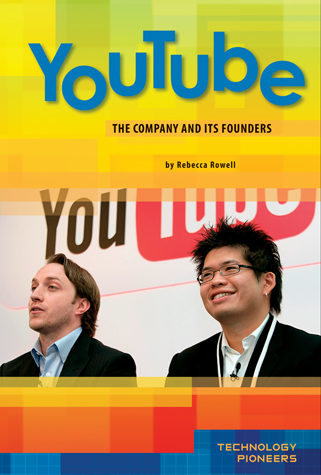
YouTube: the company and its founders


Rowell, R. (2011). YouTube: the company and its founders. Edina, MN: ABDO Publishing.

Interest level: Grades 6+

Part of the “Technology Pioneers” series, this book features ten chapters as well as a timeline, an Essential Facts section, Glossary, Additional Resources, Source notes and an Index. The chapters on the founders feature information about their childhood, hometown, education, and other career information. The text is engaging without going over the top with enough detail provided to be useful. Color photos are plentiful as are sidebars on topics such as, “What makes a video go viral?” or “YouTube and Memes” which will attract browsers.

This currency and relevance of this book make it good for biography reports or more general subject reports. The information is accurate and well supported by sources. The timeline is specific to YouTube- it would be nice if the information was placed in a larger context, comparing it to other tech happenings for comparison. This book will find its place with both researchers and kids who just want to know more about YouTube’s history.

Thursday, December 1, 2011

Negative body image


By Edward Willett

This 64-page book provides a general overview of the dangers of negative body image. Readers are told about marketing and the unrealistic ideal of the perfect body, emphasizing that everyone has a different ideal body type. There is a chapter devoted to the causes of negative body image, another that deals with the effects and finally chapters dealing with finding peace with one's body and creating awareness about the effects of negative body image.

This book contains good, factual information, but I feel that the focus is off-base. This book seems to start with the premise that only thin people can develop negative body image issues and then end up with anorexia, bulimia, and/or cutting. It never directly addresses that these same issues may affect a healthy weight or overweight person as well. This idea is reinforced by the photos of what I assume are the afflicted teens who are all poster children for the "ideal" rather than having a more diverse representation.

Willett, E. (2007). Negative Body Image. New York:NY: Rosen Publishing Group.

Good women of a well-blessed land

http://covers.powells.com/9780822500322.jpg
Interest Level: Grades 5-8
Reading Level: 7+

This book is part of  the People's History series and covers a topic which is seldom singled out. Miller accurately and fairly covers the lives of women from the colonial times through the American Revolution. There are chapters on Native Americans, white women, black women slaves, and indentured servants. Each chapter discusses the work that the women did, their stature in society, their relationships with other women in the same class and their relationships with women in other classes. Occasionally specific women are quoted, but as the author points out in the Author's Notes section, women of this era rarely recorded their thoughts. Pictures and maps round the work and there is a bibliography as well as a list of suggested books and websites.

The book is factually accurate and written in approachable language. Enough detail is provided so as to make it interesting, but not so much so as to overwhelm. This book would work well for students studying this time period or women's rights. 

Miller, B.M. (2003). Good women of a well-blessed land. Minneapolis, MN: Lerner Publications.

Sam Stern's real food, real fast


Sam Stern's real food real fast 
Interest Level: Grades 6+

Sam Stern is a teen cooking sensation and this is his second cookbook. It has a unique format in that it is divided not by course or even ingredient, but by how long each item takes to prepare. There are five tabbed sections in this cookbook with cooking and preparation time taking anywhere from 5 to 30 minutes. Sam does give the disclaimer that the times stated are how long it would take him to complete, but that he's been cooking since he was 3. Each recipe is accompanied at least one attractive color picture of the final product and sometimes a prep picture is included.

The format of this cookbook is well suited to tweens. Instructions are not extensive and are easy to follow. Sidebars are plentiful offering suggestions for substitutions based on dietary preferences or market availability. The choices are all quite healthy and Sam emphasizes the importance of real food over fake, encouraging the reader to take the time to prepare healthy and tasty fares rather than "eat fast food rubbish." This is a great cookbook for budding chefs and more experienced ones alike.

Stern, S., & Stern, S. (2006). Sam Stern's real food, real fast. Cambridge, MA: Candlewick Press.

Sunday, October 2, 2011

Leonardo's Horse


Written by Jean Fritz
Illustrated by Hudson Talbott
IL: Grades 4-7
RL: 4+

The first part of this uniquely shaped and beautifully illustrated book gives a brief biography of Leonardo da Vinci and introduces us to the 25-foot bronze horse that Leonardo was commissioned to create for the Duke of Milan. Leonardo labored over the horse for over 19 years and never saw it to completion, with many saying that "even on his deathbed he wept over it."

We are next introduced to Charlie Bend, who in 1977 read the story of Leonardo's horse in a magazine. It became his life's work to see it to completion. Unfortunately, in 1994 when Bend was nearly finished he died of Lou Gehrig's disease. Bend's family was determined to fulfill his dream, knowing that Charlie wanted it finished for Leonardo and not for his own glory. They found Nina Akamu, a New York sculptor who was finally able to carry out both Leonardo's and Bend's dreams. The horse was unveiled in Milan in 1999.

This is a well-written and beautifully illustrated book that not would not only work well in art and 7th grade history classes, but also for biography reports on da Vinci.  The unique shape of the book and the ease with which it can be read also attracts the casual reader. The book directs readers to www.leonardoshorse.org for more information.

Fritz, J. (2001). Leonardo's Horse. New York, NY: G.P. Putnam's Sons.

Elephants and Golden Thrones


Written by Trish Marx
Photographs by Ellen B. Senisi
Interest Level: Grades 4-7
Reading Level: 7+

This book tells the story of some of the emperors, princesses and even a royal elephant who lived in the Forbidden City during a five hundred year period. Readers learn Emperor Yongle commissioned the Forbidden City and was its first inhabitant. According to Chinese beliefs, the emperor was not only the ruler of China, but also a religious leader and the one who could ask for blessings from the heavens for the people of China. In building the Forbidden City, Yongle was providing an outward sign of this supreme power. 
Each chapter begins with an anecdotal account of the person it is about and then provides historical details in the following pages.  In the following pages we learn impressive details about the city, including how many buildings it has (980!), how funeral ceremonies proceeded and how you can still see traces of those rituals in China today, and other details of daily life within the city's walls.

One of the strengths of the book is its extensive use of photos taken in the Forbidden City as well as reproductions of artwork depicting daily life in the time of the emperors. The writing conveys the sense of supremeness commanded by the emperors and provides enough interesting detail to keep the reader interested. There is a timeline of each emperor's reign, a glossary and a bibliography at the back of the book. Unfortunately, there is no index or table of contents making this book less than useful for those doing reports since the entire book must be read to find desired facts. This book would be useful as an additional resource in the classroom.

Marx, T. (2008). Elephants and golden thrones: inside China's Forbidden City. New York, NY: Abrams Books for Young Readers.

Birmingham Sunday


by Larry Dane Brimner
IL: Grades 6 and up
RL: 8+

Birmingham Sunday tells the story of segregation and the impact it had on blacks in the South. The book begins with the account of the horrific day in 1963 when sticks of dynamite were placed under Birmingham's Sixteenth Street Baptist Church's stairs and detonated during services, killing four young girls. Brinmer then proceeds to provide the back story of the events that lead up to the attack. Birmingham Sunday is highly factual, providing details on the Jim Crow laws of the time, leaders on both sides of the Civil Rights movements, groups like the KKK and NAACP, Brown v. the Board of Education, and the Freedom Rides to name a few. The book is full of photos of the events of the time, allowing the reader to experience the emotions of those involved in the events. There are numerous sidebars which flesh out the story. The pages often contain large quotes that highlight the more detailed accounts given in the paragraphs. The final pages provide biographical information about the four killed as well as information on the men that carried out the attacks.

This book is incredibly powerful. Its treatment of this tumultuous time in American history is stunning. Some of the photographs are very graphic, but they are not used gratuitously, but are there to illustrate the violence that was a daily part of the Civil Rights Movement. The lack of an index make this somewhat difficult to use for specific reports on the Civil Rights Movement, but events at the time were so intertwined that even if a student were doing a report on a specific aspect they could use this for supporting material. Source notes are well detailed and there is a bibliography for further reading. This is an excellent resource for the classroom or for anyone wanting a detailed account of the time period.

Brimner, L.D. (2010). Birmingham Sunday. Honesdale, PA: Calkins Creek.


Saturday, September 10, 2011

Warriors


By Catherine Bereton
IL: Grades 5-8
RL: 4+

This book has great shelf appeal. It opens from a magnet "lock" in the middle of the front cover and looks like a gamer kid type of book. The book showcases 10 warriors from different centuries, from the Spartans through the Zulu warriors. It then pairs them in 5 battles and declares a winner.

I seriously love this book. After each battle we learn about each warrior and their strengths. The role they played in their society is detailed and details about that society are provided as well. Photos and drawings are clear, crisp and appealing. They clearly let you know when a picture may be somewhat unrealistic, as in the case with a picture of a Gladiator, which has the caption, "This Gladiator from a movie in 2000 is unrealistic, but dramatic."

All of the details are broken up on the page, making it undaunting to read and perfect for reluctant readers. It includes an index as well as a glossary.

I can see some of my gamer kids really enjoying this. And to think it's actually an accurate book! This would be a perfect addition for any  6th or 7th grade classroom or a school library. 

Harpur, J. (2008). Warriors: all the truths, tactics, and triumphs of history's greatest fighters.  New York, NY: Atheneum.

Friday, September 2, 2011

You wouldn't want....

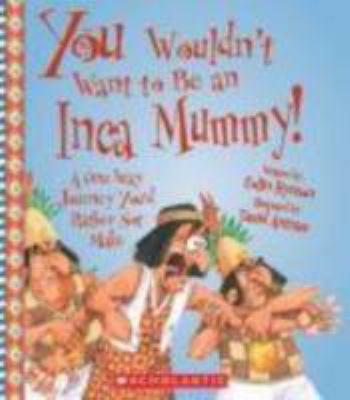
You wouldn’t want to be an Inca mummy
Written by: Colin Hynson
Illustrated by: David Antram

IL: Grades 4-7
RL: 5+


This series has 20+ titles and the format is especially appealing to the age group for whom they are written. They are factually correct and contain all the gory bits and details, accompanied by comical drawings that they really speak to their audience. 

These books are published by the Salariya Publishing Company, a company that seems to have figured out what they do well and continue to do it.

This particular volume appealed to me because it seems that there isn’t a lot of browsing/ quick read type material on the Ancient Incas,  which in California must be taught according to the State Standards. This would make a good addition to any middle school library or 7th grade classroom.

While reading ...Inca mummy I found myself learning things about the Inca Empire that I was clueless of. For instance, did you know that once the dead Sapa Inca (which means “only emperor”) dies all but his eldest son (the new Sapa Inca) had to parade the mummified body through all the empire for a year followed by mourners?

Each chapter is only 2 pages and contains a lot of illustrations, making them very accessible to all readers. The “Handy Hints” contained in each chapter alternate between hilarious, gruesome and just plain “eeew!” Even better, each contains a glossary and an index, which are sometimes missing in funner type non-fiction. 

Pick one up. I bet you’ll find yourself laughing, learning, groaning, and maybe even feeling squeamish all in one short read.

Hynson, Colin. (2008). You wouldn't want to be an Inca mummy. New York, NY: Franklin Watts.